.svg)

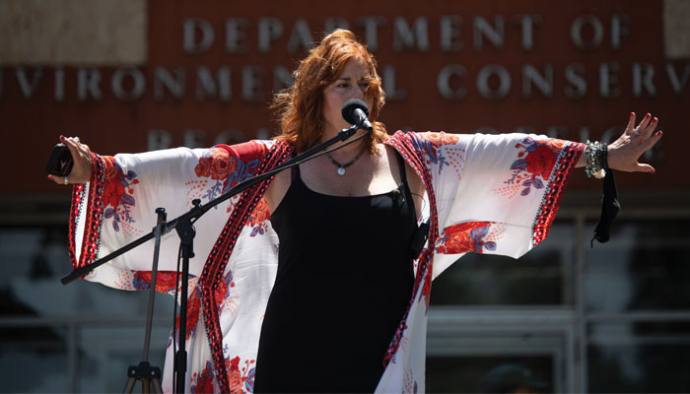
Meet Yvonne Taylor, Finger Lakes Climate Activist
Key Points
- An "accidental activist," Yvonne Taylor began organizing at her kitchen table with two others and, over an eight-year fight against a multi-billion-dollar gas corporation, built a coalition of ~500 Finger Lakes wine and tourism businesses backed by resolutions from every municipality in the region.
- Yvonne frames climate action as inseparable from caring for the next generation, arguing that older and younger generations must work together to fight for a livable planet on behalf of the children in their lives.
- Yvonne raises concerns about hyperscale AI data centers, describing their high energy and water demands, the health effects of constant low-level noise from cooling systems, declining property values, and increased reliance on fossil fuels and nuclear power to meet electricity needs.
Key Points
- Research what potential hazards may occur in your community.
- Sign up for your county’s emergency alert system.
- Use the questionnaires below to identify your needs during a disaster.
Tools
- Research what potential hazards may occur in your community.
- Sign up for your county’s emergency alert system.
Yvonne Taylor is an environmental activist and school teacher whose work bridges the gap between grassroots organizing and community education. Living on her family’s generational land along the shores of Seneca Lake, Yvonne was thrust into activism when she discovered plans to convert the area into a major gas storage and transport hub. What began as a kitchen-table conversation among neighbors grew into a multi-year, multi-stakeholder movement that successfully blocked the project.
Today, Yvonne serves as the Vice President of the Seneca Lake Guardian and the founder of the National Coalition Against Cryptocurrency Mining. She remains deeply engaged in the fight to protect the Finger Lakes region from industrial expansion. By day, she works with at-risk youth, a role that informs her belief that environmental stewardship and the well-being of future generations are inextricably linked.
Our Conversation
In our recent interview, Yvonne and I discussed the challenges of modern climate advocacy and the importance of intergenerational collaboration. Our conversation covered several key areas:
- The Power of Grassroots Mobilization: Yvonne shared her journey as an "accidental activist," emphasizing that effective change often starts locally and grows through community building, stakeholder engagement, and sheer persistence.
- Intergenerational Responsibility: We discussed how the need to provide a livable planet for the youth of today acts as a powerful motivator for older adults. Yvonne noted that everyone has young people in their lives, whether it’s students, children, or grandchildren, and that protecting their future is a universal imperative.
- The Threat of AI Data Centers: A major focus of our talk was the emergence of hyperscale AI data centers. Yvonne explained how these facilities threaten local ecosystems by consuming massive amounts of energy and water, producing constant noise pollution, and providing little economic benefit to the communities they occupy.
- Collective Action: Yvonne highlighted that while the climate crisis can feel overwhelming, individuals don't need to tackle it alone. She advocates for a "symphony" approach to activism, where every person identifies their specific "instrument", be it writing, donating, or organizing, and contributes in whatever way they can.
- A Message to Future Generations: Ultimately, Yvonne’s message is one of empowerment. She urges younger generations to use their voices, as their participation is essential to the movement for a sustainable future.
Mobilizing Across Generations
During our discussion on how to inspire older generations and long-time activists to deeply care about climate issues, Yvonne shared a powerful perspective on the universal bonds that tie us to the planet's future:
"I think all of us... have young children in our lives, whether they be nieces, nephews, students, grandchildren, our own children, and you know we care deeply about these young individuals, no matter what their relationship is, and if we care deeply about them, then we absolutely must care about their future climate, and you know there is no, no real hopeful outlook for these children unless they have a livable planet on which to reside."
On what keeps her hopeful:
Frannie: What keeps you hopeful about our environmental future?
Yvonne: "I'll have to admit that sometimes I'm not hopeful... but what gives me hope is every single one of us who is stepping up to fight back, and we're doing it by the thousands. We just two weeks ago went to Albany and were met with thousands of people from all across New York State who essentially took over the state capitol for the entire day."
On advice for people who want to get involved:
Frannie: "What advice would you give someone who might want to get involved in environmental advocacy, particularly for older adults who might feel like they are limited in what they can do?"
Yvonne: "I'm going to quote environmentalist Sandra Steingraber, who said that we're in the middle of a symphony, and what each one of us has to do is pick up our instrument and play it with all our might. It doesn't matter what your instrument is, you may be able to make a donation to a nonprofit, you may be able to send a letter to your elected official or make a phone call to your elected official. You may be able to learn more by attending a webinar or going to a forum on the subject. You may be able to organize your own activity, maybe it's a call-in relay. You may be able to participate in many different ways. Maybe you're technologically savvy, maybe you're a good writer, maybe you're a good musician — you can implement any of your talents toward this movement in whatever capacity you feel, and it could be two minutes a day, and that would be enough, but we need all of us."
As we continue our work with the Cornell Initiative for Research on Climate and Aging, these insights serve as a vital reminder that climate action is most effective when it is collaborative, persistent, and grounded in the communities we seek to protect.